Authors: Zichen Li, Renald Brenner, Lucas Frérot
The real area of contact governs, in part, the magnitude of the friction force, yet its time evolution in rough viscoelastic interfaces remains incompletely understood. In experiments of contact between polymethylmethacrylate blocks under decreasing normal loads, Dillavou and Rubinstein have shown that the true contact area exhibits, after unloading, a decreasing phase and long-term memory of the contact state prior to unloading. It is however unclear what modeling ingredients are necessary to reproduce these two features. Here, we investigate these effects using fractional viscoelastic rough contact models. By adapting existing contact theories and numerical simulation methods to fractional viscoelasticity, which induces a wide relaxation spectrum, we reproduce logarithmic aging under constant load, but show that memory of the contact state is erased upon unloading. Indeed, the contact area behaves as if it had always experienced the reduced load, even on short time-scales, contrasting with the response of a standard linear solid. Moreover, none of our results show a decreasing regime of the contact area after unload: we ultimately prove that this is the case for all linear viscoelastic models—despite capturing logarithmic aging—leading to the conclusion that additional local internal variables are required to explain both long-term contact memory and contact area reduction after unloading.
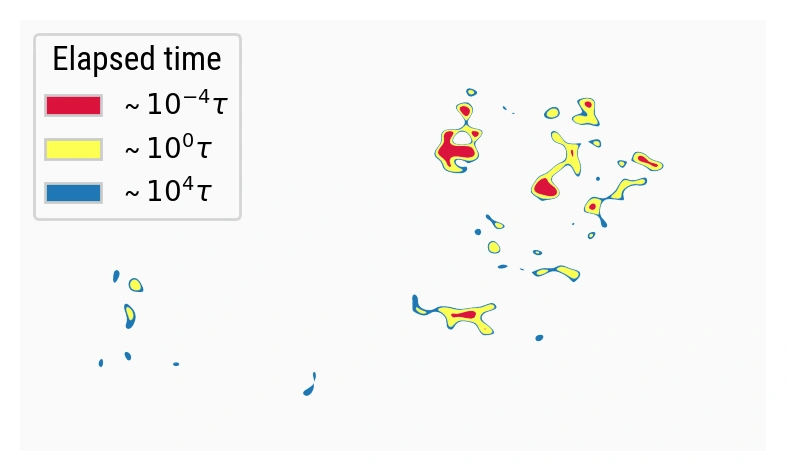
Cover art: made with Matplotlib, computed with Tamaas